
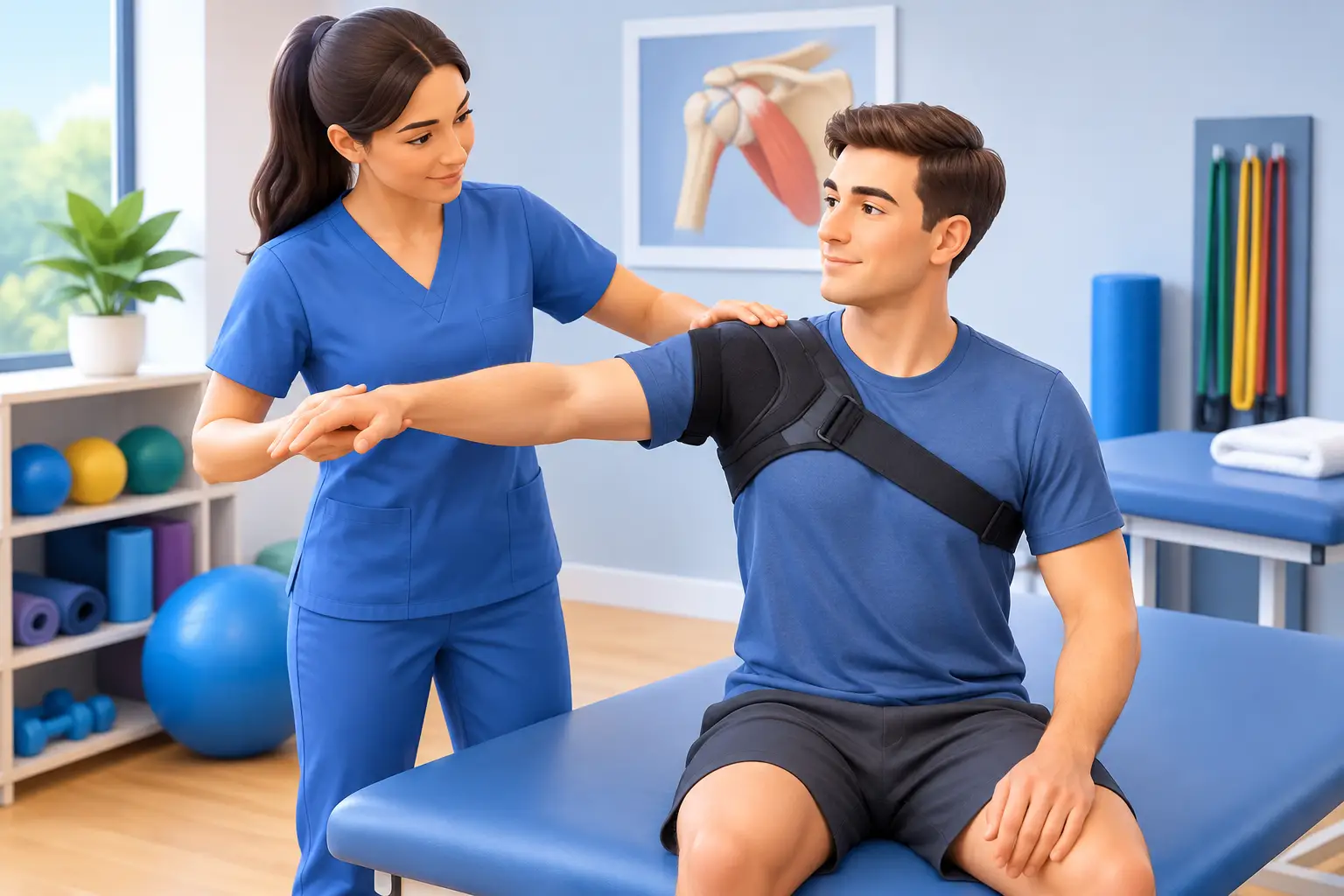
Reaching for a coffee mug, fastening a seat belt, or sleeping comfortably can feel surprisingly difficult after shoulder surgery. These everyday challenges are exactly why a well-planned rehabilitation program matters. Physiotherapy after shoulder surgery is not simply about getting the arm moving again. It is a gradual, evidence-based process that protects the repair while helping you rebuild mobility, strength, confidence, and control.
Every shoulder, procedure, and recovery goal is different. Your surgeon’s instructions are the starting point, and your physiotherapist uses them to create a plan that fits your healing stage, pain level, work demands, and the activities you want to return to.
Why shoulder rehabilitation needs a careful plan
The shoulder is designed for movement. It relies on the coordinated work of the ball-and-socket joint, shoulder blade, rotator cuff muscles, tendons, ligaments, and surrounding muscles. Surgery may repair or reconstruct one of these structures, but the area needs time to heal before it can safely tolerate force.
Moving too little can contribute to stiffness, muscle weakness, guarded posture, and loss of confidence. Moving too much, too soon can irritate sensitive tissue or place stress on a repair that is not ready for it. The right rehabilitation plan finds the middle ground.
This is especially relevant after procedures such as rotator cuff repair, shoulder replacement, labrum repair, stabilization surgery for recurring dislocations, biceps tendon surgery, or surgery to address severe arthritis. Recovery timelines vary significantly between these procedures. A person recovering from a minor arthroscopic procedure may progress differently than someone recovering from a large tendon repair or joint replacement.
Your physiotherapist should work within your surgeon’s protocol, not against it. If a restriction says not to actively lift the arm or bear weight through it, those limits are part of protecting the surgical result.
The early phase: protect the shoulder and manage discomfort
During the first days and weeks, the focus is often protection. You may be wearing a sling, dealing with swelling, sleeping poorly, and relying more heavily on your other arm. It is common to feel uncertain about how much discomfort is normal.
Early physiotherapy may include education about sling use, comfortable positioning, sleeping support, and safe ways to dress or move around the home. Your physiotherapist may also guide gentle hand, wrist, elbow, neck, and upper-back movements to limit stiffness in areas that were not operated on.
Depending on the procedure and surgeon’s directions, treatment may also include passive range-of-motion exercises. Passive means your arm is moved with assistance from your other hand, a therapist, or a support tool, rather than the shoulder muscles doing the work. This can help preserve motion without asking the healing tissues to contract forcefully.
Pain should be monitored, not ignored. Mild soreness after approved exercises can be expected, particularly as activity increases. Sharp pain, a sudden major increase in pain, new swelling, or pain that stays elevated well after exercise deserves attention. A physiotherapist can help you distinguish normal rehabilitation discomfort from signs that the program needs to be adjusted.
Physiotherapy after shoulder surgery: restoring movement
As healing progresses and your surgeon clears additional activity, rehabilitation shifts toward restoring active movement. This is the stage where many people want to push quickly because they are tired of limitations. Patience remains valuable.
Your physiotherapist may begin with controlled movements that help you relearn how to raise, rotate, and reach with the arm. Good movement is not only about how far your shoulder goes. It is also about how the shoulder blade, upper back, and rotator cuff work together.
A common compensation is shrugging the shoulder toward the ear when lifting the arm. Another is leaning the trunk to reach farther. These patterns can make a movement look successful while placing unnecessary strain on the neck and shoulder. Guided exercise helps address these habits early, before they become automatic.
Hands-on treatment may be used when appropriate to address muscle guarding, stiffness around the shoulder or upper back, and restricted movement in nearby areas. Treatment should always match your surgical precautions and current tolerance. The goal is to make exercise more comfortable and effective, not to force range of motion.
Strength comes after control
Strengthening is a major part of recovery, but it is rarely the first step. Before loading the shoulder with bands, weights, or demanding functional tasks, you need enough motion and control to perform exercises safely.
A progressive program often begins with low-load muscle activation. From there, it may advance to rotator cuff strengthening, shoulder-blade control, pulling and pushing patterns, carrying tasks, and work- or sport-specific movements. The exact order depends on your surgery, symptoms, and goals.
For example, an office worker may need to build tolerance for computer use, driving, and overhead filing. A parent may prioritize lifting a child safely. A recreational athlete may need the endurance and control to return to tennis, swimming, golf, or the gym. These goals require more than generic exercises. They require a plan that reflects how you actually use your shoulder.
Progress is not always linear. You may have a week where motion improves quickly, followed by a slower period with more soreness or stiffness. This does not automatically mean something is wrong. Your physiotherapist can assess what has changed, modify your home program, and help you progress at a pace that supports long-term results.
What your home program should feel like
Your home exercises are an important extension of your appointments, but more is not always better. Performing exercises with the wrong technique, adding extra repetitions without guidance, or trying an online exercise that is not appropriate for your procedure can delay recovery.
A helpful home program should be clear, manageable, and specific to your stage of healing. You should understand how often to perform each movement, what sensations are acceptable, and when to stop. Consistency matters more than intensity in the early stages.
Use pain and fatigue as information. If exercises create mild, temporary soreness that settles reasonably, your body may be adapting. If they produce sharp pain, repeated catching, marked swelling, or symptoms that worsen from one session to the next, contact your physiotherapist or surgical team before continuing at the same level.
When to contact your surgeon or physiotherapist
Some discomfort, bruising, and sleep disruption can be part of early recovery. However, do not wait for your next scheduled appointment if you notice warning signs. Contact your surgeon or seek urgent medical advice for fever, chills, increasing redness or drainage around the incision, calf pain or unusual shortness of breath, sudden loss of function, or severe pain that feels different from your usual post-operative symptoms.
You should also speak with your physiotherapist if you are unsure about your restrictions, struggle to complete your exercises, or feel anxious about using the arm. Questions are part of rehabilitation. Clear guidance can prevent unnecessary setbacks and reduce fear around movement.
A personalized approach supports better recovery
Effective shoulder rehabilitation considers more than the operated joint. It considers your posture, upper-back mobility, neck symptoms, sleep, work setup, activity level, and previous injuries. It also considers the human side of recovery: frustration when progress feels slow, worry about reinjury, and the desire to return to normal routines.
At Happy Harmony Physiotherapy, shoulder rehabilitation is guided by individualized assessment, hands-on care when appropriate, and progressive exercise built around surgical guidelines and personal goals. With deep experience in complex shoulder recovery and collaboration with shoulder surgeons, the focus is on helping patients move forward with clarity and confidence.
Recovery is not a race to lift the heaviest weight or reach the highest shelf first. It is a series of well-timed steps that lets healing tissue become a capable, reliable shoulder again – so the movements that matter in your life can gradually feel like your own.
Leave a Reply